
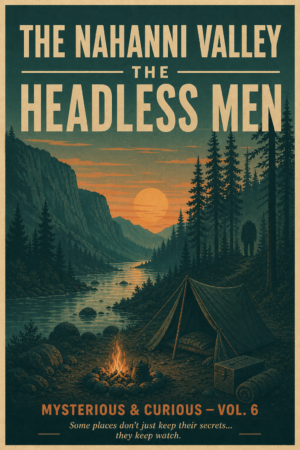
Mysterious & Curious (Vol. 6) – The Nahanni Valley of the Headless Men
The Nahanni Valley of the Headless Men
Canada’s Darkest Mystery


From an ancient stretch of untouched country, cradled deep within the mist-laced spine of the Mackenzie Mountains, the Nahanni Valley has long resisted explanation.
For thousands of years, the Dene people have spoken of what lives there — not as myth, but as memory.
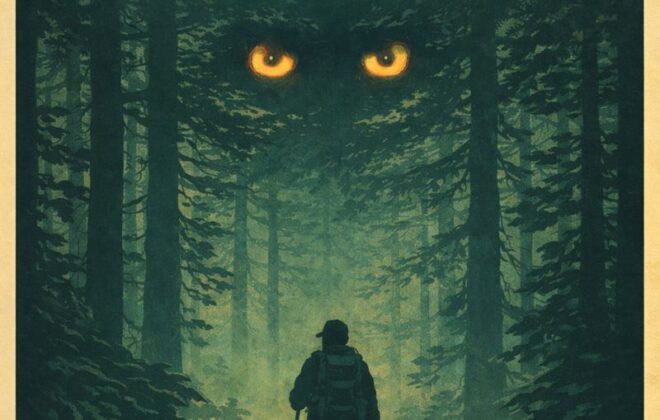
They tell of the Nakani — towering, cave-dwelling giants with red eyes and an appetite for human flesh. Creatures that move just beyond the reach of firelight. Close enough to hear. Never close enough to see clearly.
Others describe something older.
Something that doesn’t belong to any known era.
Prospectors returned from the valley shaken, whispering about massive shapes moving through steam rising off unnatural hot springs. Places where the air shifts suddenly, warm against the cold, as if the land itself is hiding something alive beneath it.
And always, there is gold.
Not the kind that built cities —
but the kind that draws people into places they shouldn’t go.
The kind that doesn’t want to be found.
Because in the Nahanni, men didn’t just lose their fortunes.
They lost their direction.
Their sanity.
And sometimes… their heads.
Where the Nahanni Actually Is


Despite how often it’s pulled into Western Canadian lore, the Nahanni Valley isn’t in British Columbia.
But it’s closer than most people think.
From northern B.C. — past Prince George, pushing toward Fort Nelson — the road eventually thins, then ends. Beyond that point, the map begins to lose its detail. The land gets larger. Quieter. Less certain.
Cross into the Northwest Territories, and you reach the edge of the Nahanni.
It cuts through the jagged backbone of the Mackenzie Mountains, following the winding force of the South Nahanni River. There are no highways leading into it.
To get there, you fly in — or commit to a multi-day expedition by canoe.
Once you’re in, you’re hours — sometimes days — from the nearest help.
It Started With Gold
The first accounts weren’t warnings.
They were invitations.
Gold had been spotted — or believed to be — somewhere deep within the valley. Enough to draw experienced prospectors north, each one convinced they might be the one to find it.
But alongside the promise came something else.
Something harder to explain.
Members of the Dene people had long avoided certain areas.
They spoke of the Nakani.
Until men started disappearing.
The McLeod Brothers


In 1905, Frank and Willie McLeod entered the Nahanni Valley with the same intention that had drawn others north — gold.
They were not inexperienced men.
They understood the terrain, the risks, the isolation. This wasn’t reckless exploration. It was a calculated journey into a place that, even then, carried a reputation just beyond explanation.
When they didn’t return, it didn’t immediately raise alarm.
In that part of the country, time stretches. Seasons pass. Men stay out longer than planned.
But as years went by, the silence surrounding the McLeod brothers began to feel less like delay — and more like absence.
Then, they were found.
Deep within the valley, far from any easy route in or out, searchers came across what remained of their camp. It wasn’t scattered. It wasn’t stripped. It hadn’t been overtaken in the way you would expect if something had gone wrong suddenly.
Their supplies were still there.
Tools. Equipment. The quiet structure of a working site, left behind as if it had simply… stopped.
There were no signs of a struggle.
No clear indication that they had tried to flee.
No evidence that anything had forced them to abandon what they had built.
And then there were the bodies.
Both men were discovered nearby.
Decapitated.
Their skulls were never recovered.
There were no clear tracks.
No weapons left behind.
No explanation that held under scrutiny.
Predators were considered — but the conditions didn’t align.
Violence was considered — but there was no evidence of intrusion.
Environment was considered — but it does not account for what was found.
What remained was not just the deaths themselves —
but the absence of a cause.
A clean break in logic.
The kind that leaves a story unfinished, no matter how many times it’s told.
And from that point on, the Nahanni was no longer just a place where men went missing.
It became known as a place where something had happened —
and never explained itself.
Martin Jorgensen


In the years following the disappearance of the McLeod brothers, another prospector — Martin Jorgensen — made his way into the Nahanni Valley, drawn by the same quiet promise of gold.
Unlike those who passed through quickly, Jorgensen appeared to settle in.
He constructed a small cabin, chose his ground carefully, and began working the surrounding area. By all accounts, his setup suggested intention — not desperation. This wasn’t a man lost or wandering. It was someone methodically staking a claim in a place few were willing to remain.
For a time, nothing seemed out of the ordinary.
Until his camp was found.
The cabin had been destroyed by fire.
Not partially burned or damaged — but reduced to charred remains, the structure collapsed in on itself. The surrounding area showed signs of intense heat, as though the fire had taken hold quickly and completely.
Jorgensen’s body was discovered within the ruins.
There was no clear evidence pointing to how the fire began — no confirmed accident, no documented cause, no indication of external interference that could be definitively proven. In remote conditions like the Nahanni, fire is always a risk. A tipped lantern. A cooking flame left too long. A moment of inattention.
But one detail remained.
A message, attributed to Jorgensen, was reportedly recovered from the site:
“Something tried to get me last night.”
The statement is often repeated, sometimes debated, occasionally dismissed.
But it persists.
Not as proof —
but as a fragment.
A single line, left behind in a place where explanations tend to stop just short of certainty.
John O’Brien


Another case frequently referenced is that of John O’Brien — and while it is often categorized as exposure, the details leave a quieter kind of unease.
O’Brien had established a small, functional camp within the valley. There were no signs of disarray — no scattered supplies, no indication that something had forced him to leave in haste. His gear remained where it should have been. The structure of the camp suggested routine, not disruption.
He was later found deceased not far from that same campsite.
Close enough that, under normal circumstances, reaching shelter would not have required significant effort.
The official conclusion pointed to exposure — a common and well-documented risk in northern environments, where temperatures can shift rapidly and conditions can deteriorate without warning.
But certain elements stood out.
In typical cases of hypothermia, individuals often exhibit what’s known as paradoxical behaviour — signs of confusion, erratic movement, or attempts to wander. Tracks are usually present. Disturbance in the surrounding area is expected. There is often evidence of a struggle against the elements, even in its final stages.
Those indicators were not consistently reported in O’Brien’s case.
There was no clear path showing he had tried to leave.
No strong evidence that he had attempted to reach warmth.
No immediate explanation for why he had remained so close to safety without using it.
It was, on paper, a straightforward conclusion.
And yet, when placed alongside the other cases in the Nahanni, it begins to feel less complete.
Not because it cannot be explained —
but because it doesn’t fully explain itself.
The Pattern
Individually, each case could be explained.
Together, they share consistent characteristics:
- Individuals entering alone
- Camps left intact
- Limited evidence of struggle
- Unusual causes of death
Fire.
Freezing.
Decapitation.
The Land Itself


The Nahanni is not only remote — it is geologically unlike anywhere else in northern Canada.
Cut through by the powerful currents of the South Nahanni River, the valley is defined by sheer canyon walls that drop hundreds of meters, exposing layers of ancient limestone and dolomite carved over millions of years. In places, the rock faces feel less like landscape and more like architecture — vertical, imposing, and unnervingly still.
Water moves differently here.
At Virginia Falls, the river plunges with a force nearly twice the height of Niagara, sending up a constant plume of mist that drifts through the surrounding forest. The air carries a mineral weight — damp, metallic, alive.
And then there is the heat.
Geothermal hot springs emerge unexpectedly from the valley floor, feeding strange, terraced formations that rise like something preserved from another age. Warm water flows year-round, even in deep winter, creating pockets of green in an otherwise frozen environment. Moss, algae, and rare plant species thrive here, clinging to a climate that shouldn’t exist this far north.
Because in some ways, it doesn’t.
Unlike much of the surrounding region, sections of the Nahanni escaped the last glacial advance. While ice sheets flattened and reset the rest of the north, this valley remained partially untouched — a kind of ecological holdover. Older soil systems, unique plant life, and subtle irregularities in the terrain persist, giving the landscape a feeling that is difficult to place.
It doesn’t feel new.
It doesn’t even feel old in the way other places do.
It feels… uninterrupted.
As though whatever has shaped this valley has been allowed to continue, quietly and without interference, for far longer than it should have.
The Nakani
Long before prospectors arrived, the Dene people spoke of the Nakani.
Within Dene oral tradition, they are described as large, human-like figures associated with mountainous terrain and cave systems.
In modern interpretations, these accounts are sometimes compared to Sasquatch or other unidentified hominids.
The consistent theme, however, is not identification — but avoidance.
The Psychological Edge
Isolation, environmental stress, and extreme cold can significantly impact human perception.
Conditions such as disorientation and “frost madness” have been documented in remote northern environments.
However, these explanations do not fully account for all reported aspects of the Nahanni cases.
The Quiet Theory
Some believe the Nahanni is misunderstood.
Others suggest it is a place where natural, environmental, and cultural factors intersect in ways that are not fully understood.
A place that resists certainty.
Field Notes
There’s a difference between being alone in the wilderness
and feeling alone.
Most places offer silence that feels open.
The Nahanni does not.
Its silence feels contained.
Held.
Like something is just beyond it.
The Question That Stays
The Nahanni still exists, largely unchanged.
Protected today as a national park reserve, it is recognized globally for its ecological and geological significance.
People still visit.
Most return.
But the stories remain.