
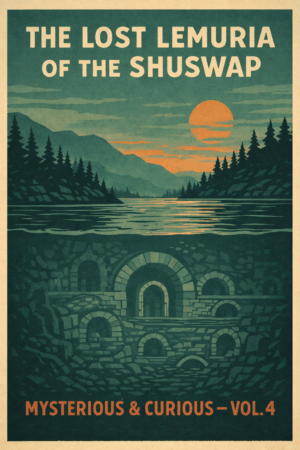
Mysterious & Curious (Vol 4.) – The Lost Lemuria of the Shuswap
The Mountain That Moves
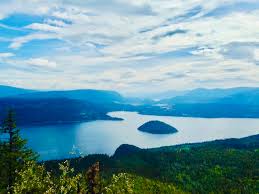
There’s a part of Shuswap Lake where the water feels heavier—like it’s hiding something. The air changes just slightly, and the trees seem more watchful. Locals will tell you, if they trust you enough, that something sleeps beneath those mountains. Not in a metaphorical sense. Not a ghost or a myth. A city. An ancient one.
Call it Lemuria. Call it the land before the land. Call it what you want. The story holds: an underground city lies beneath the Shuswap, and those who’ve gone looking for it don’t always come back the same.
This is a story that stretches from Victorian-era science to Indigenous oral traditions, spiritual seekers, underground tunnels, and strange mountain echoes. It’s a story with no clean edges and no verifiable truths—and that’s exactly why we’re telling it.
What is Lemuria—and Why Here?
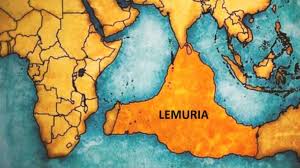
Lemuria began as a scientific proposal in the 19th century. Zoologists were puzzled over why lemur fossils appeared in both Madagascar and India, but not Africa or the Middle East. Before the theory of plate tectonics was widely accepted, scientists imagined a lost land bridge: Lemuria—a vast, sunken continent that once connected distant lands.
That theory eventually faded, but the name lived on—especially within the Theosophical Society and other metaphysical circles. Lemuria transformed into something far more intriguing: a peaceful, spiritually advanced civilization that supposedly thrived in the Pacific region before being lost to time and cataclysm.
Most stories of Lemuria were anchored to Mount Shasta in Northern California. But over the decades, whispers of Lemurian energy, underground dwellings, and crystalline cities began to surface farther north—in Oregon, Washington, and British Columbia.
One location in particular seemed to hold something deeper: the Shuswap Lake region, where the mountains rise steep and quiet, and where stories older than memory still echo.
The Secwépemc and the People Below
Long before Lemuria became a spiritual shorthand for paradise lost, the Secwépemc Nation told stories of beings who lived beneath the land.
Some oral traditions speak of a great fire or upheaval that drove people into caves, where they lived and adapted. Others describe small, pale beings who emerged only at night, or tunnels used to travel great distances beneath the earth.
These stories are not speculation—they are sacred. They are passed down through generations with care and intention. Some may interpret them symbolically, others literally. But all agree: they carry meaning that still resonates today.
We want to be clear: these stories are not Lemurian. They belong to the Secwépemc. But the parallels—underground refuges, wisdom in the dark, transformation through disaster—are what draw seekers, researchers, and storytellers to explore deeper connections.
Are these intersections a coincidence? Shared archetypes? Or hints of something much older than we understand?
Tunnels, Echoes, and Disappearances
By the mid-20th century, the Shuswap region was developing a quiet reputation for strange phenomena. Early reports from trappers, miners, and surveyors included tales of echoing caverns, disorienting magnetic fields, and “moving stone” hillsides.
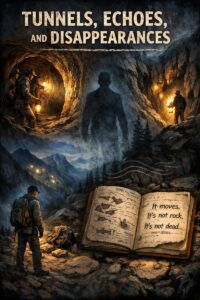
One of the more widely circulated accounts dates to 1959, when a local outdoorsman named Gerald Thompson reportedly discovered a tunnel entrance in the mountains north of the lake. He and two companions ventured inside with ropes and lanterns, but were turned back by what they described as a “bone-rattling hum”. The next day, they returned—but the entrance was gone.
In later decades, hikers described seeing lights deep in cliffside crevices, far too remote for any conventional explanation. Some reported feeling a low vibration under their feet, or claimed to see carvings in stone they couldn’t identify.
There are also missing persons cases that have become part of the mythology. One of the most whispered is that of a mineral surveyor from the University of Victoria who vanished in the 1970s. His notebook, later found, contained increasingly erratic observations and a final note: “It moves. It’s not rock. It’s not dead.”
Theories of the Tunnels
Some believe the Shuswap is part of a vast subterranean tunnel network said to stretch across the Pacific Northwest—connecting Mount Shasta, Oregon’s Crater Lake, and regions of B.C.
These theories aren’t taught in university geology departments, but they persist in alternative research communities and spiritual circles. Proponents speak of quartz-lined corridors, ancient doorways sealed by frequency, and knowledge stored deep in the earth.
There are even speculative maps, like those explored in David Hatcher Childress’s writings or Richard Shaver’s underground narratives. While mainstream science dismisses them, they continue to inspire pilgrimages and investigations.
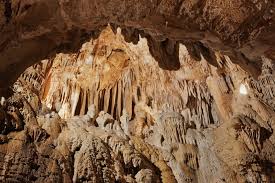
Some real-world geological features may support aspects of the mystery. The Shuswap area includes karst formations (limestone regions shaped by water over time), which can create natural caves and tunnels. The region’s tectonic complexity also gives rise to seismic fissures and hot springs.
So while no physical Lemurian city has been unearthed, the land does whisper of movement beneath.
What the Stories Mean
According to Dr. Eliza Tennant, a cultural anthropologist at UBC whose work focuses on mythology and memory across cultures.
“The moment you ask whether these stories are ‘true’ in a physical sense,” she said, “you risk overlooking their real power. These narratives survive because they speak to something deeper—something spiritual, ancestral, or emotional.”
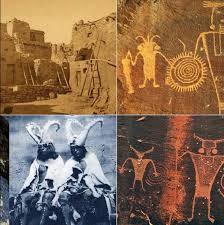
She noted that cultures across the world—from the Hopi to the Quechua—carry stories of underground people or inner-earth journeys.
“It may be memory. It may be metaphor. But these stories echo because they mark thresholds—between the living and the dead, the seen and the unseen.”
When asked directly about Lemuria, she smiled.
“I don’t use the term. But I do believe some places hold old knowledge. I’ve walked near the lake, and I’ve felt it. The land remembers.”
The City You Can’t Map
So—does a hidden city lie beneath Shuswap Lake? Are Lemurian beings still watching us from quartz halls under the mountain?
Maybe not in the way you’d expect. But something’s there.
A pull. A presence. A story passed down through bloodlines, songs, books, and intuition. Whether it’s a literal city or a metaphysical echo, the mystery persists because people feel it—before they name it.
And that’s the magic of it. Lemuria doesn’t need to be proven to be real.
Stand at the edge of the water, somewhere quiet. Feel the silence.
You might hear something beneath the surface. Something older than time.
Have you heard a story about the Shuswap caves, Lemurian visions, or underground cities in B.C.?
📬 Reach out at [email protected]